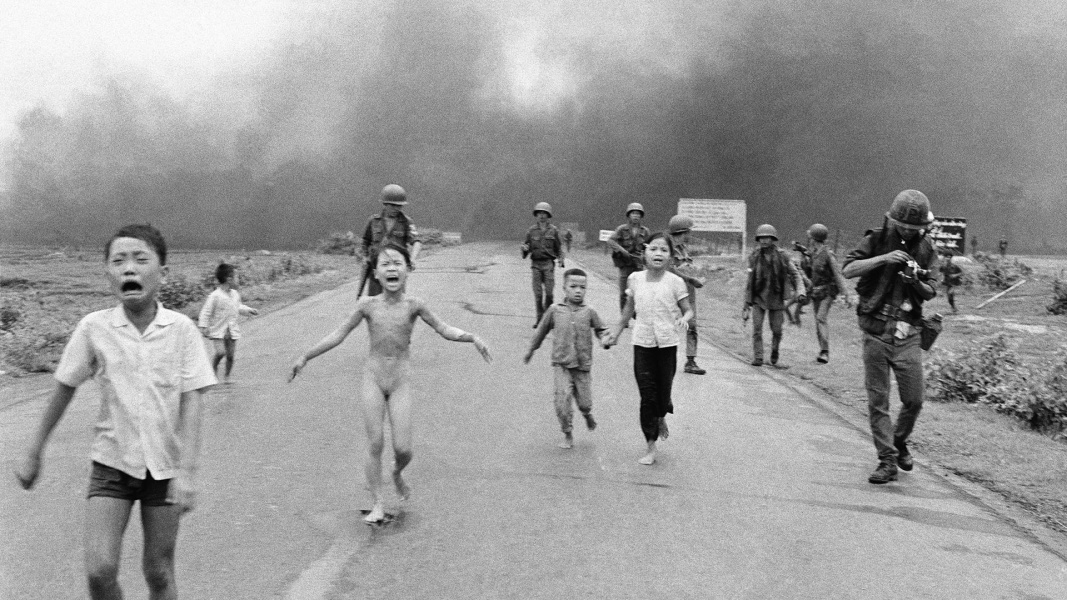
For this assignment I have chosen, Napalm Girl by Nick Ut. This image, as powerful as it is, also has a personal attachment for me on different levels, firstly, I am in the military, this image is a stark reminder of atrocities that can happen in war. Secondly, this image was used in my photography aptitude examination, it was the first time I realised the power of a single image.
When you examine how much difference A single image could make, you would think that a black and white photo of a screaming child arms open running from a flaming village, skin melting from the effects of Napalm would be enough to stop any war, or at the very least provoke change, or does the bombardment of horrific images just make us numb to the atrocities that the world keeps turning up generation after generation?
In 1972 when Nick Ut first shared his image of Napalm Girl, originally named The Terror of War (1972) it was a reminder that a still image has the potential to tell a story, make a statement in a universal language and evoke emotion in a single captured moment. It soon became one of the most iconic images, of the most contentious war, America has ever fought, the Vietnam war. Napalm Girl, subsequently went on to win the Pulitzer prize in 1973. Although much weight is given to the media for turning public opinion against the war in Vietnam. This image was seen the world over on the front cover of magazines and newspapers alike. How much can A still image actually change the course of a war?
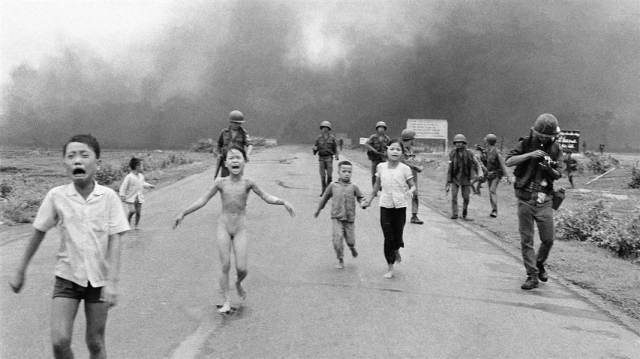
The Associated Press (AP) was founded in 1886 to supply speedier battle reports from the war in Mexico. It became the eminent force in photo journalism during the Vietnam war, where they won 6 Pulitzer prizes 4 of them going on to become images that still represent that war and the devastating effect it had on civilians to this day. In this article Pyle is quoted “Nick Ut’s unforgettable image of 9-year-old Kim Phuc running down a road, her clothes burned off and her skin peeling, as she and others fled a napalm bombing attack by South Vietnamese planes on an enemy position — widely regarded as the other picture of the war” (Pyle, 2017)
It is maintained, the emotional attachment the public had with the image, significantly changed their stance on the war and therefore the conclusion of the war. The opposing argument was, support for the war was already dwindling and that the ongoing media coverage was just representing the publics opinion on it. Some will also point to the lack of evidence used to support these reports.
Even though The Vietnam war was coined the ‘living room war’ originally by Michael Arlen, whilst reporting for the New Yorker in 1960, due to the extensive coverage given by news agencies and for the first time and the freedom given to the press during this conflict. It was the still 35mm images that were telling the story. According to Pyle “Even television, making its own battlefield debut in Vietnam, lacked the impact of the small 35-millimeter camera, the tool of choice for photojournalists.” (Pyle, 2017)
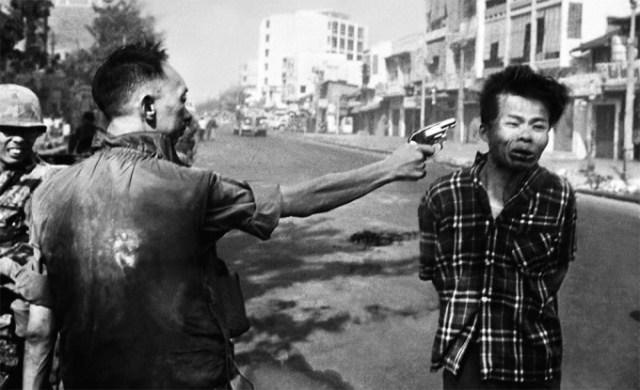
The critic Susan Sontag remarks in her 1977 book On Photography that “a naked South Vietnamese child just sprayed by American napalm, running down a highway toward the camera, her arms open, screaming with pain—probably did more to increase the public revulsion against the war than a hundred hours of televised barbarities.” (Sontag, 1977) The unparalleled power of photographs wasn’t simply because the camera had become “the tool of choice for photojournalists,” (Sontag, 1977) as Pyle attests, but because photography, as Sontag described, “are a neat slice of time, not a flow. Television is a stream of underselected images, each of which cancels its predecessor. Each still photograph is a privileged moment, turned into a slim object that one can keep and look at again.” (Sontag, 1977) Together with Nick Ut’s picture, Eddie Adams image of General Nguen Ngoc Loan executing a Viet Cong Prisoner in Saigon is probably the other most unforgettable image of the Vietnam War. There is actual video footage of both these same events which rarely gets a look in compared to the visceral snap shots of the still photographs. Some of this is to do with the timing of the news footage going out, some scenes to disturbing for prime time television meant the real gore was saved for print media.
With images as strong as these, it is no wonder people claim they effect public opinion. Some would argue that the media was and always is just a reflection of an already waning public support for the war. According to the myth busting author and Professor W.Joseph Campbell, “By June 1972, American public opinion had long since turned against the war in Vietnam. Nearly 60 percent of respondents to a Gallup poll conducted early in 1971 had said that the United States had made a mistake by sending troops to fight in Vietnam. (Gallup periodically has asked since 1965, when just 24 percent of respondents said it was a mistake to have sent troops to Vietnam. (W. Joseph Campbell, n.d.) By August 1968, a majority of respondents said it had been a mistake.) Ut’s photo can hardly be said to have galvanised opinion against the war: That shift had taken place years before.”
An LA times 2017 report goes on to make the point that the war ended 6 months later. This is, in fact, a myth, the conflict rumbled on with South Vietnam troops fighting on for a full 3 years after the photo was taken. To further the argument Campbell goes on to say “By June 1972, the war was essentially over for American forces in Vietnam. President Richard Nixon had announced in November 1971 that U.S. ground operations had ended in South Vietnam and by June 1972, nearly all U.S. combat units had been removed from the country.” (W. Joseph Campbell, n.d.)
According to the Fred Greene’s, 1970 Journal article, The Case For and Against Withdrawal from Vietnam and Korea “ The case for withdrawal, based on a notion of Hanoi’s actions are, if not justified, understandable, and that Communist governments in Southeast Asia are neither particularly dangerous to us nor anathema to their populaces. Vietnamization has many advantages for us, but, given a weak government, runs the risk of a failure, endangering American troops. Troops should be withdrawn from South Korea, both for its good and our own.” (Greene., 1970) The fact this was published a full two years before Ut’s famous image is further proof of political opinion, it also furthers the discussion of public opinion preceding Ut’s picture, “ A crucial point is that the American public today cannot be convinced of the value of continuing the war given the costs involved, the doubtful nature of the outcome, and the pressing needs that have manifested themselves on the domestic front.” (Greene., 1970) This is further evidence that, in truth, the media were more likely to be using these images to echo the already growing political and public opinions.
As much as the media would like to take credit for the end of the war and over inflate their role in it, the hard truth is, nothing really changes as Sontag put it ““photographs cannot create a moral position but they can reinforce one—and help build a nascent one.” (Sontag, 1977)
Much credit should be given to Ut’s and any war photographer that place themselves in danger to share these amazing images that stir emotion and create debate. Sontag continues that we require “existence of relevant political consciousness” in order to be “morally affected by photographs. Ultimately, It is the consensus of the public that ends conflicts not the images that represent them.” (Sontag, 1977)
Therefore, as powerful an image as this is, I do not believe that it is the images themselves that change the course of public opinion on wars. It seems the most probable outcome is, the images are a solid reflection of public and political opinion. Picture editors, reporters and news crews cannot help but to be swayed by such opinions. Couple that with the statistics from the Gallup poll and the social science journals published years before the images were taken and the irrefutable facts that nearly all US combat troops had already been removed from Vietnam by the time Ut’s image was even taken, it becomes harder to justify the claims that images alone are responsible for ending the conflict.
The fact that a harrowing photograph such as this can have a happier ending than most is heart-warming. Ut an already award winning photographer, went on to have a glittering career with The Associated Press and Phuc, after surviving the Napalm attack, Phuc was used as propaganda for the Vietnam regime. She eventually managed to escape to Canada, where she has since gained citizenship and is the founder of the Kim Phuc Foundation International for children injured in conflict. As recently as, February, 2019, Phuc was awarded the Dresden award for Peace, for her work with UNESCO as an ambassador for peace. Ut and Phuc remain good friends until this day.
Not all images of this type can boast such a happy ending for those concerned but I’m glad in this case it did.
 Ben's Blog